
DIGITAL TWINS
Twins that sharpen as your data does.
You should not need a full instrumentation project to get a useful model of an account. AquaAdvisor twins run at four fidelity tiers, and the same asset model carries forward as you add signal.

WHAT IT ACTUALLY DOES
What it actually does
Progressive fidelity
Start on controller and lab data; add sensors, hourly speciation, then higher-fidelity correction without rebuilding the asset identity.
State estimation
Estimate chemistry and asset state from telemetry and lab results using estimation methods suited to the tier (UKF / EnKF / particle / moving-horizon).
Forecasts with uncertainty
Forecast saturation, deposition, corrosion rate, and thermal penalty with uncertainty bands and provenance — not a single opaque score.
Asset-bound identity
Model identity persists across cleanings and retubes so hindcasts and baselines stay comparable.
Value of information
Analysis that tells you which sensor is worth recommending next — instead of instrumenting everything first.
ASSET ENTRY
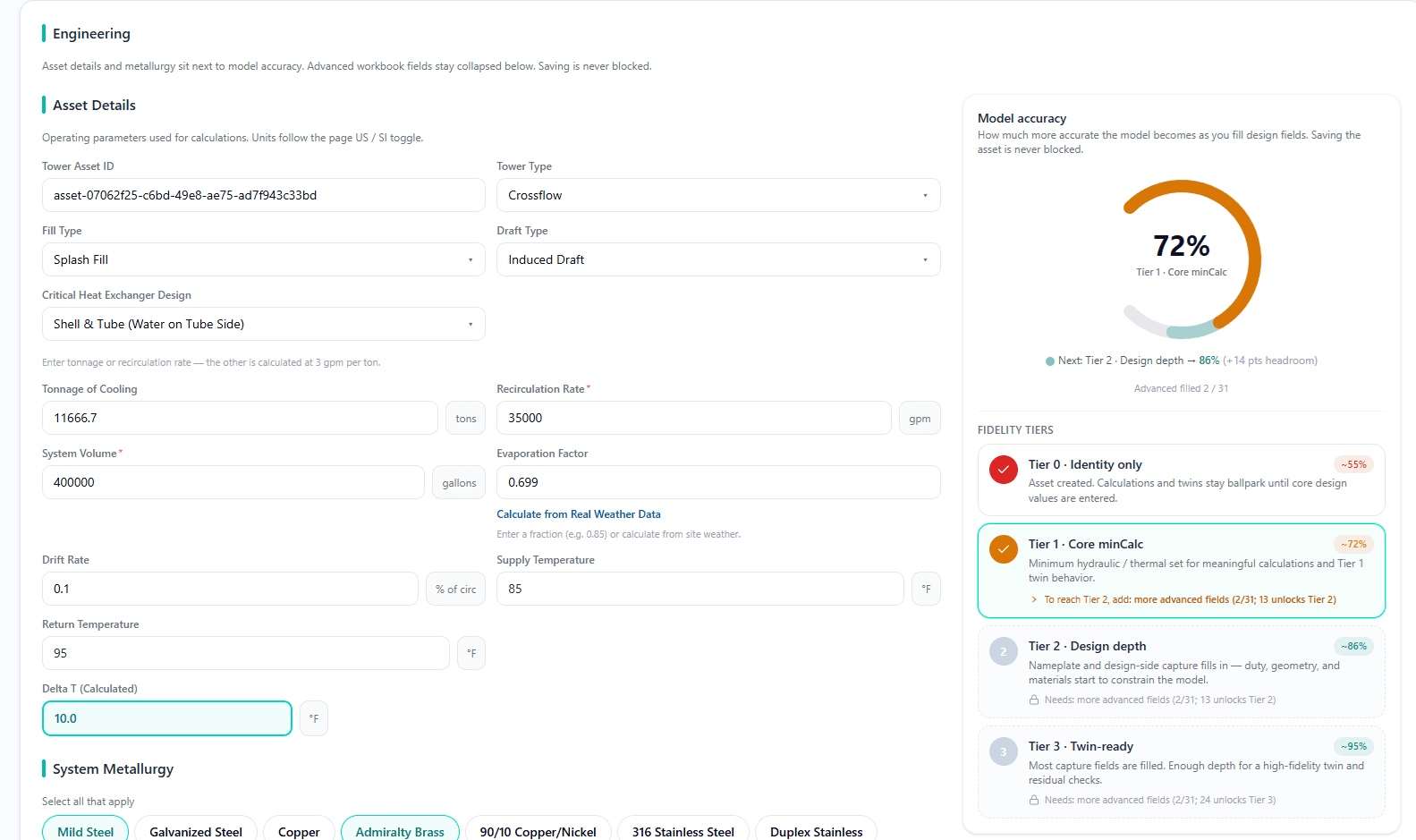
Every field added to an asset sharpens the model
Start with what you have. Saving is never blocked, and the accuracy gauge shows what the next fields are worth. These data-completeness tiers sit beneath the twin fidelity ladder below.
Tier 0 · Identity only (~55%)
Asset created; calculations are ballpark.
Tier 1 · Core minimum set (~72%)
Flow, volume, temperatures, and evaporation.
Tier 2 · Design depth (~86%)
Nameplate, duty, geometry, and metallurgy.
Tier 3 · Twin-ready (~95%)
Most fields filled; ready for a high-fidelity twin.
Percentages are the product's model-accuracy guidance for each data-completeness tier, not a guarantee for a specific asset.
FIDELITY LADDER
Four tiers. Same asset model.
Select a tier to see what data it needs and what it can predict.
DIFFERENTIATOR
Prediction, not trending
Hindcast validation, forecast horizons with uncertainty bands, asset-bound model identity that persists across cleanings and retubes, and value-of-information analysis that tells you which sensor is worth recommending next.
AI LAYER
AI on twins and estimation
The AI watches residuals and narrates forecasts — it does not invent a twin state without the chemistry underneath.
Twin residual monitoring
Watches the gap between the twin's prediction and measured reality. A twin that stops tracking gets flagged for re-anchoring instead of quietly producing confident nonsense.
AI-assisted re-anchoring
When residuals climb, the AI surfaces which inputs and assumptions drifted — so engineers re-anchor against evidence, not guesswork.
Value of information
Tells you which additional measurement would most reduce forecast uncertainty, so instrumentation spend is targeted.
Forecast narratives
AI-generated explanations of what the twin is forecasting and why — citing solved chemistry, uncertainty bands, and the time window.
HOW IT WORKS
Twin anatomy
Process, chemistry, estimation, and operations layers — plus learning, uncertainty, and governance planes.
Process / asset layer
Bind the twin to the physical asset: tower, exchanger, boiler, membrane, or loop — with operating constraints and geometry where known.
Chemistry layer
Call the physical chemistry solver at the fidelity the data supports; report residual, database, and activity model.
Estimation layer
Assimilate telemetry and lab results; produce state estimates and forecasts with uncertainty.
Operations layer
Surface alarms on modeled state, program actions, and field-facing forecasts — not raw-threshold charts alone.
Governance
Retain provenance, hindcast validation, and model identity so technical and compliance reviews can audit the twin.
OUTPUTS
What you get out
- Saturation, deposition, corrosion, and thermal-penalty forecasts with uncertainty
- Hindcast validation against measured history
- Asset-bound baselines that survive cleanings and retubes
- Value-of-information recommendations for the next sensor
- API access to chemistry and twin state for the connected asset
WHO THIS IS FOR
Who this is for
- Service companies that need portable, vendor-neutral twins across the accounts they treat
- Technical directors who need prediction, not another trending dashboard
- Field and account teams managing uptime risk for customers
- Branch and corporate technical groups standardizing models across a multi-account fleet
See a twin on an asset class you treat.
30-minute technical walkthrough with an engineer — bring controller and lab data from an account if you have them.