
AI LAYER
AI-delivered insight, supervision, and optimization.
AquaAdvisor's AI does not replace the chemistry model. It reads it. That is the entire difference between a recommendation you can defend with a customer and one you cannot.
THE POSITIONING
AI that stands on real chemistry
Physics first, AI second
Most water AI is pattern-matching on sensor history. Ours reads the output of a physical chemistry solver, so recommendations are constrained by thermodynamics and kinetics rather than by whatever correlated last quarter.
Insights and reports
Plain-language interpretation of what the chemistry and assets at your accounts are doing, with the reasoning shown — monthly and quarterly reports written from the actual solved state, not templates you fill in.
Supervision
A continuous watch over telemetry streams and twins across your accounts: sensor drift, bad lab data, and models that have stopped tracking reality — flagged before you decide on a bad number.
Optimization
Recommended setpoints and program adjustments that balance scale, corrosion, water use, energy, and chemical cost against the constraints you declare for the account.
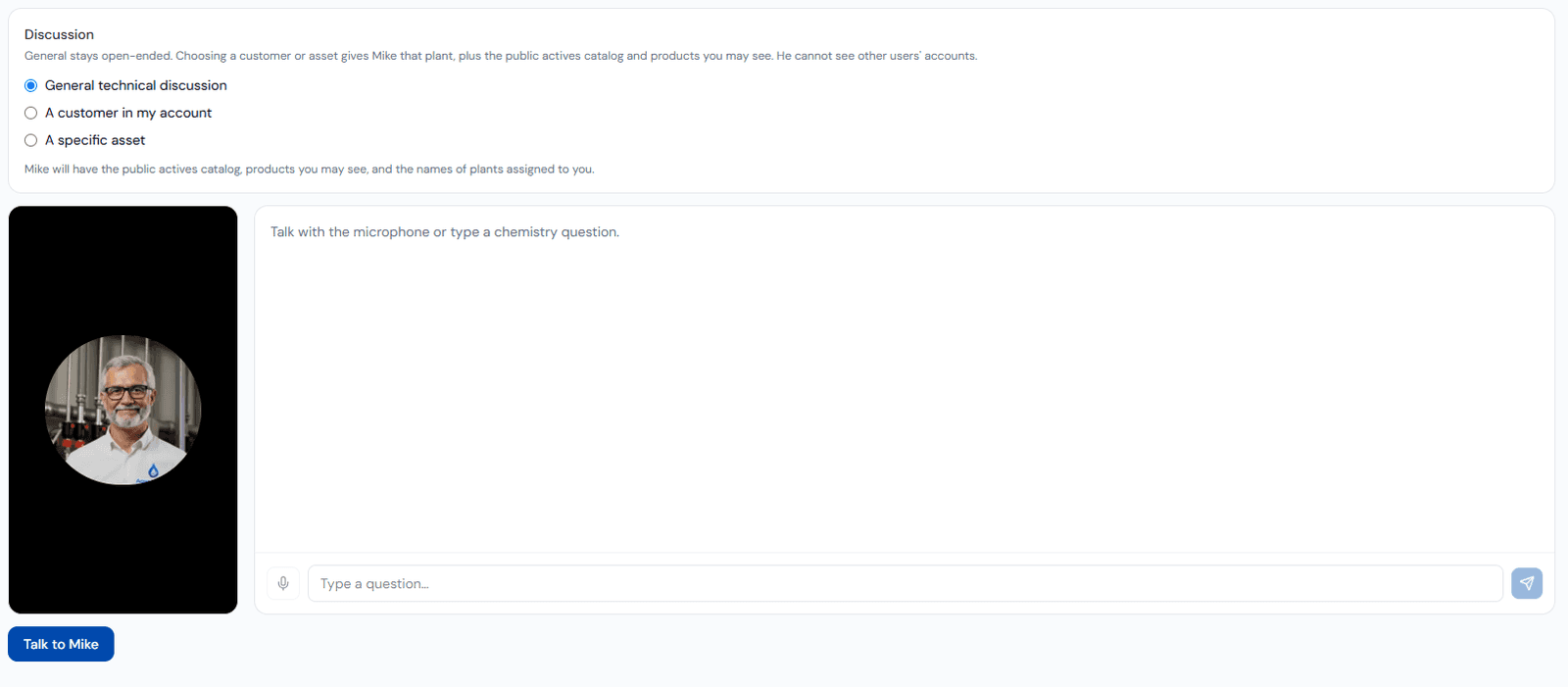
AI INDUSTRY TECHNICAL CONSULTANT
Mike: a senior water-treatment consultant every rep can talk to
Voice or text, inside AquaAdvisor. Mike answers from the asset record and the solved chemistry — not from a generic chatbot.
General discussion
Open technical questions on water, process, and equipment.
A customer
Mike sees that plant and the products you are permitted to see.
A specific asset
Answers use that asset's chemistry, program, limits, and history.
Private by design
Mike cannot see other users' accounts.
Example exchange
You
Orthophosphate is 13.5 ppm with calcium at 295. What is the risk?
Mike
Calcium phosphate deposition on hot exchanger surfaces. Trim phosphate feed back toward the control band and inspect the hottest exchanger first.
Troubleshoot an excursion
Explain a report to the customer
Compare program options
Equipment guidance
Train new reps
Prepare for a visit
THE ARCHITECTURE
Four bands. AI only consumes what is below it.
Telemetry and lab data → physical chemistry solver → digital twin and estimation → AI layer.
AI layer
Interpretation, supervision, optimization, reporting — over computed chemistry, not raw correlations.
Digital twin and estimation
State estimate and forecast with uncertainty — the AI watches residuals and narrates forecasts.
Physical chemistry solver
Speciation, saturation, kinetics, corrosion electrochemistry — residual and provenance on every result.
Telemetry and lab data
Measured reality — controllers, sensors, and laboratory results bound to assets.
HOW IT WORKS
Consume the stack. Never invent the chemistry.
The AI layer only ever consumes the layer beneath it. It has no path to a conclusion the chemistry does not support.
Ingest measured reality
Telemetry and lab data land on assets. The AI does not invent measurements — it supervises their quality against mass balance and model expectations.
Solve the chemistry
The physical chemistry solver produces speciation, saturation, kinetics, and corrosion electrochemistry with residual and provenance on every result.
Estimate and forecast
Digital twins and estimation produce state estimates and forecasts with uncertainty — the AI watches residuals and narrates what the twin is saying.
Interpret, supervise, optimize
Insights, alarms, and recommendations are generated over computed chemistry. Humans review anything that changes how the site is operated.
INSIGHTS AND REPORTS
AI-delivered insights and reports
Turns a solved chemistry state and twin forecast into an explanation a person can act on — what changed, why it changed, what it will do next, and what to do about it.
Automated reporting
Monthly and quarterly program reports, exception summaries, and management rollups generated from the accounts you treat, with model outputs and assumptions attached. Editable before you send them to the customer.
Root-cause narratives
When an index moves or a deposition rate climbs, the AI walks contributing terms — makeup chemistry, cycles, temperature, inhibitor residual, holding time — and names the driver.
Ask-your-system queries
Natural language questions against the accounts you treat ("which of my towers is closest to gypsum saturation this month, and what changed?"), answered from computed chemistry rather than from a text search.
Traceable by design
Every generated insight cites the underlying values, the model version, and the time window. Nothing is asserted without a traceable number behind it.
SUPERVISION
AI supervisory layer on telemetry and twins
Sensor validation and drift detection
Cross-checks each stream against lab results, mass balance, and the chemistry model. Flags the probe that is lying before it becomes a decision.
Twin residual monitoring
Watches the gap between the twin's prediction and measured reality. A twin that stops tracking gets flagged for re-anchoring instead of quietly producing confident nonsense.
Anomaly detection on modeled state
The alarm is "predicted calcite saturation at the hot wall is crossing the deposition threshold," not "conductivity is above a number someone typed in 2019."
Alarm triage and deduplication
Correlates related alarms across streams and assets into one explained event with a probable cause and a severity.
Data quality scoring
Every asset carries a confidence score reflecting how much of its state is measured, how much is inferred, and how stale the inputs are.
Escalation and hand-off
Routes to the right assignee with the evidence attached — into the Legionella corrective-action workflow or the contract obligation record where relevant.
OPTIMIZATION
AI optimization of system operations
Setpoint and program optimization
Cycles of concentration, blowdown, pH control, oxidant and inhibitor dosing, side-stream operation — recommended against predicted scale, corrosion, and biological risk rather than against a rule of thumb.
Multi-objective trade-offs
Water consumption, energy penalty from fouling, chemical cost, discharge limits, and asset risk — optimized together with the constraints you declare for the account. That is the framing a technical director actually lives in.
Constraint-aware and bounded
Every recommendation is bounded by the site's operating envelope, material limits, permit limits, and the program you specified. The AI cannot recommend outside the box you define.
Scenario and design optimization
Search across feed sources, treatment strategies, and equipment configurations using batch solving, and return a ranked set with the chemistry behind each option.
Value of information
Tells you which additional measurement would most reduce uncertainty, so instrumentation spend is targeted.
Human in the loop by default
Recommendations are proposed, reviewed, and approved. Closed-loop actuation is a deliberate, separately enabled capability — currently on roadmap.
AI VISION
Photographic analysis
Concrete, visual, and unusual — screening and trending that standardizes inspection without replacing the lab.
Corrosion coupon analysis from photographs
Photograph a coupon and get a structured assessment: attack type (general, pitting, crevice, under-deposit), coverage, deposit character, and severity — recorded against the asset and comparable over time.
Deposit and fouling photography
Surface and deposit images assessed and tied to the predicted deposit composition from the chemistry model.
Lab report and document extraction
Water analyses, lab reports, and program documents read directly into structured, analyzable data.
Photographic assessment is a screening and trending aid that standardizes and preserves visual inspection. It supplements laboratory analysis and coupon mass-loss measurement rather than replacing them.
GUARDRAILS AND GOVERNANCE
What closes a technical buyer
Physics first
No AI output exists without an underlying solved chemistry state.
Traceable
Every insight cites its inputs, model version, database version, and time window.
Bounded
Recommendations are constrained by declared operating envelopes and program specifications.
Reviewable
A human approves anything that changes how the site is operated.
Auditable
AI-generated content entering a compliance record is logged in the append-only audit trail with its inputs.
Your data
Used to serve you. Training and cross-tenant data-use policy details are confirmed per engagement.
Deployment
The AI layer is available in both cloud and on-premise deployments — same capabilities, the customer's perimeter when the account requires it.
WHAT IT DOES NOT DO
A short, confident list
- It does not replace your water treatment engineer.
- It does not dose chemicals on its own unless you explicitly enable and configure that — closed-loop actuation is on roadmap and separately enabled.
- It does not produce a number it cannot show the chemistry for.
OUTPUTS
What the AI layer produces
- Plain-language insights that cite underlying values, model version, and time window
- Automated monthly and quarterly program reports with model outputs and assumptions attached
- Root-cause narratives for index moves and deposition-rate climbs
- Natural-language answers against data from the accounts you treat, grounded in computed chemistry
- Sensor validation, drift flags, twin residual alerts, and data-quality scores
- Bounded setpoint and program recommendations with multi-objective trade-offs shown
- Value-of-information guidance on which measurement would most reduce uncertainty
WHO THIS IS FOR
Who this is for
- Technical directors who need AI they can defend in a customer review
- Field teams that want supervision of telemetry and twins without black-box scores
- Account managers who need AI-drafted narratives they can send to customers
- Service companies that require the same AI capabilities in cloud or on-premise — including air-gapped accounts
See the AI layer on an account’s water analysis
Bring a lab report from an account to the demo and get an AI-generated insight set from real computed chemistry, live.